

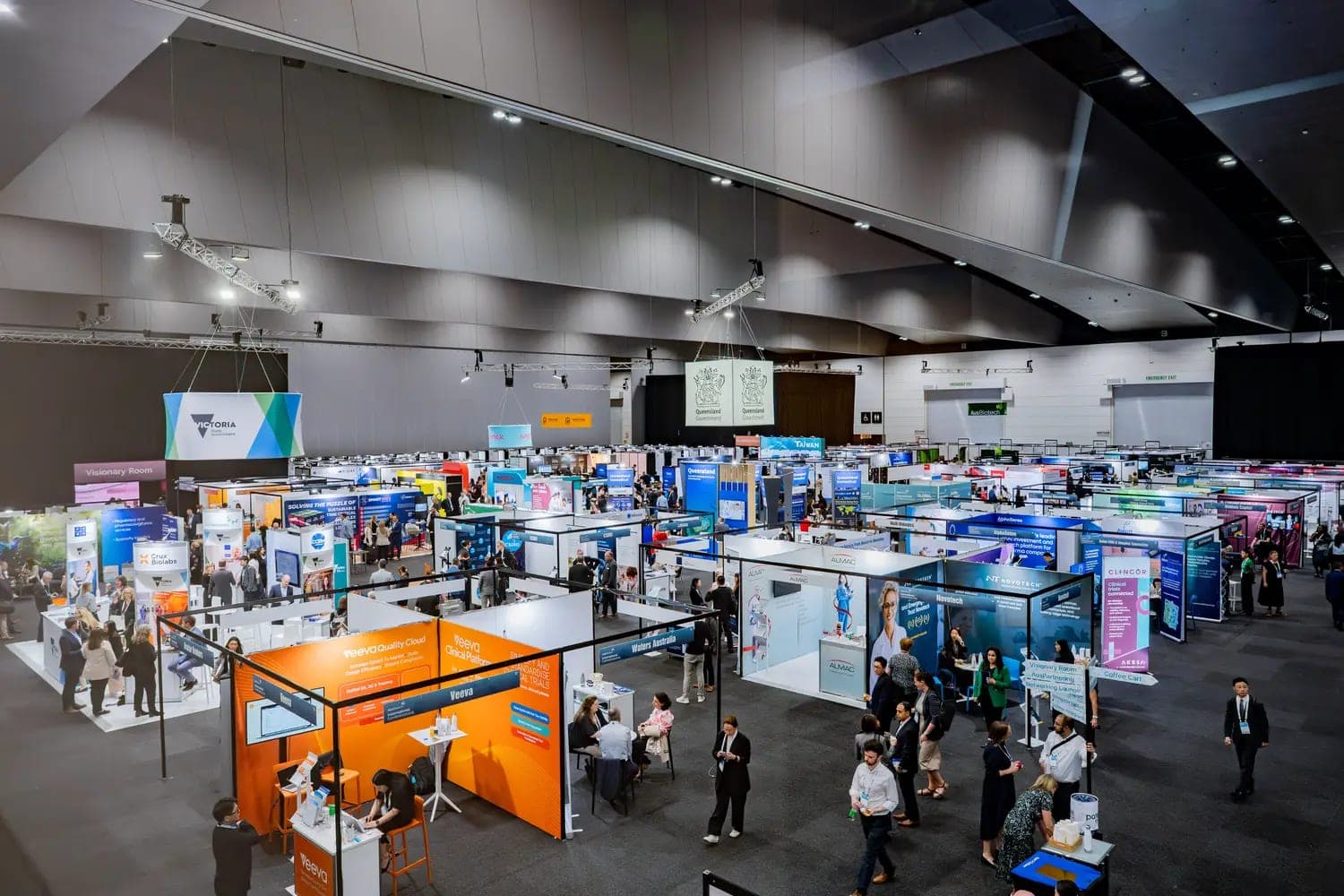
Managing 50+ exhibitors without losing your mind
Once you cross about 30 exhibitors, the way you manage an exhibition fundamentally changes. What used to be manageable with a spreadsheet and a good memory becomes a rolling operational crisis. Not because anyone is incompetent, but because the volume of concurrent, interdependent tasks overwhelms the tools most organisers are using.
This isn't about compliance documents (we've covered that) or the exhibitor's own experience (we've written about that too). This is about what the organiser's day actually looks like when 50 exhibitors all need different things at the same time.
The communication problem
Fifty exhibitors means fifty different points of contact, each with their own questions, timelines, and levels of responsiveness. One is asking about electrical specs. Another wants to know if they can bring a custom rig. A third hasn't responded to anything in two weeks. Someone's PA is emailing on behalf of the exhibitor but isn't cc'd on the original thread, so they're missing context.
Your inbox becomes a wall of unrelated exhibitor queries, all mixed in with venue logistics, speaker coordination, and everything else that running an event involves. Finding the email where Exhibitor #24 confirmed their power requirements means scrolling through weeks of threads. Replying to the wrong thread — or worse, the wrong exhibitor — becomes a real possibility.
At this scale, email isn't communication. It's noise.
Booth assignment and floor plans
Assigning 50 booths is straightforward on paper. In practice, it's a spatial puzzle with commercial constraints. Platinum sponsors get the prime positions. Competing companies can't be placed next to each other. Some exhibitors need double power. Others need water access. One needs a corner booth because of their display rig.
Most organisers manage this with a combination of a floor plan image (often a PDF from the venue or, yes, a PowerPoint slide) and a separate spreadsheet mapping booths to exhibitors. Change one, and you have to remember to change the other. When an exhibitor upgrades their tier mid-process, both documents need updating — and whoever updates them needs to know the spatial implications.
Tier management at scale
Platinum, gold, silver — or whatever naming convention your event uses — each tier carries different entitlements. More floor space. Better placement. Branding in the programme. Inclusion in the networking dinner. Speaking slots. The number of variables per tier multiplies quickly, and tracking who gets what across 50 exhibitors in a spreadsheet is an exercise in inevitable error.
The real pain hits when a sponsor upgrades or downgrades mid-cycle. Suddenly their booth allocation changes, their branding entitlements shift, and someone needs to manually update every system that tracks these separately.
The logistics coordination
Bump-in schedules alone can be a logistical puzzle. Fifty exhibitors can't all arrive at 7am on setup day. Some need forklift access. Some have freight arriving from overseas on a different timeline. Electrical requirements vary wildly — from a single power point to three-phase power for industrial displays.
Then there's signage. Who's submitted final artwork? Whose banner dimensions are wrong? Who changed their company name six weeks ago but nobody updated the fascia order?
These details individually are trivial. In aggregate, across 50 exhibitors, they're overwhelming. And they're typically tracked across a spreadsheet, an email folder, a shared drive, and the coordinator's mental model of the event.
Payments and invoicing
Exhibition revenue isn't one transaction per exhibitor. There's the initial booth fee, then add-ons: extra power, additional passes, sponsorship upgrades, networking event tickets. Some exhibitors pay on invoice, some on credit card. Some have 30-day terms. Some are perpetually overdue.
Tracking this in a spreadsheet — or worse, reconciling it manually against your accounting system — is slow and error-prone. Every hour spent on invoice chasing is an hour not spent on production.
The old way
The honest summary of how most exhibitions are managed: a master spreadsheet with too many tabs, an email inbox organised by exhibitor name (if you're disciplined) or not at all (if you're human), a shared folder on Google Drive or SharePoint that someone forgot to update, and a production coordinator who holds it all together through sheer force of memory.
This works. Until it doesn't. And at 50 exhibitors, the margin between "works" and "doesn't" gets very thin.
How ema handles it
We built ema's exhibitor management around the assumption that you're dealing with dozens of exhibitors, not a handful.
Exhibitor records linked to floor plan booths. One system, one source of truth. Move a booth on the floor plan and the exhibitor record updates. Change a tier and the allocation adjusts. No dual-entry, no forgotten spreadsheet updates.
Tier-based requirements applied automatically. Define what each tier includes — booth size, branding entitlements, compliance requirements — and ema applies the right set to each exhibitor. Upgrades and downgrades propagate across the system.
Per-exhibitor discussion threads. Every conversation with an exhibitor lives in one place, visible to your whole team. No more digging through inboxes or wondering who replied to what. Context travels with the record, not with the person who happened to send the email.
Integrated invoicing through Xero and Stripe. Booth fees, add-ons, sponsorship upgrades — invoiced and tracked within ema, synced to your accounting system. Payment status is visible per exhibitor without switching tools.
AI agent for quick status checks. "Which exhibitors haven't paid?" or "Who's missing bump-in details?" — ask the agent and get answers in seconds instead of opening three tabs and cross-referencing.
The organiser's perspective
We've written about exhibitor compliance as a document-tracking problem, and about the exhibitor's experience as a service-design problem. This is the third angle: the organiser's day-to-day operational reality. The constant context-switching, the fear of dropping a ball, the sense that you're managing your tools instead of your event.
At 50 exhibitors, you need a system that scales with the complexity. Not another spreadsheet. Not another email folder. A single workspace where every exhibitor, every booth, every invoice, and every conversation lives together.
That's what ema is built for.